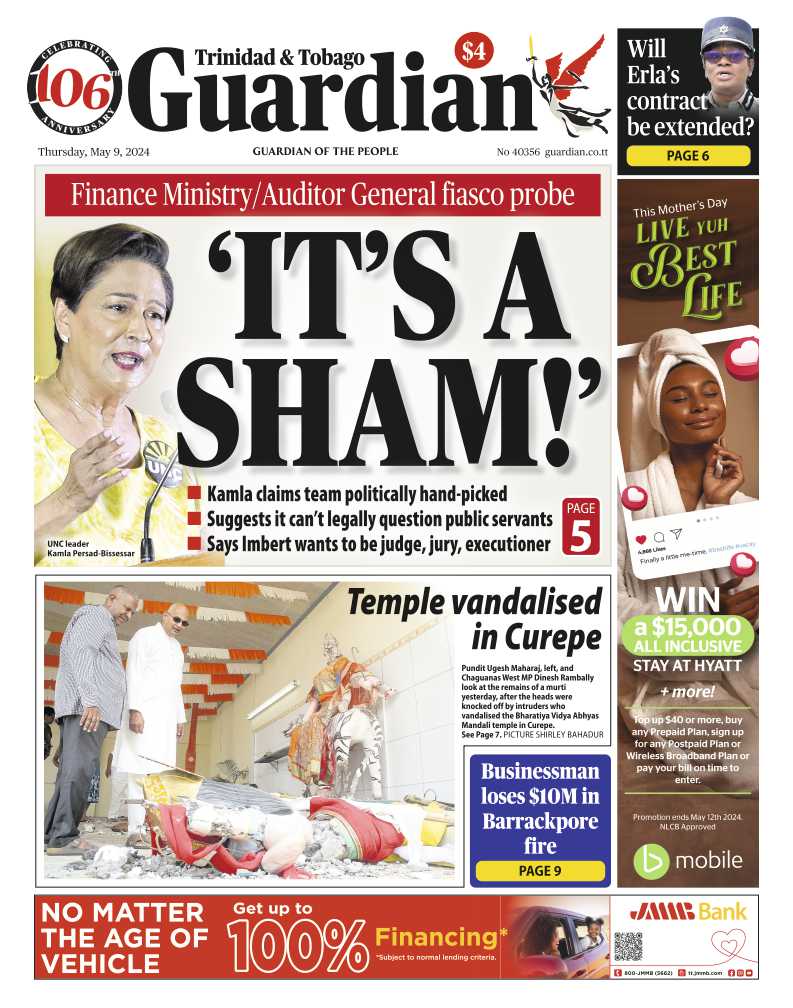
It has been seven and a half months since the newly elected administration has taken office and has had to take a full stock of the challenges facing the country. Since the United National Congress (UNC) won the April 28 General Election, the Kamla Persad-Bissessar-led Government has had to focus on triage across all sectors of the country, whilst preparing to transition into the hard and often unglamorous work of governing.
Against that backdrop, the Prime Minister’s reality check, signalled to Government officials, that the year ahead will bring a heavier workload, underscores the levels of seriousness and intensity required as the Government seeks to accelerate its agenda. Trinidad and Tobago’s economic, social and institutional problems existed long before the change of administration, and they required urgent attention from day one.
Speaking at the UNC’s annual Christmas fundraiser on Saturday, Persad-Bissessar attributed delays to systems and bureaucracy, while insisting the Government would not give up. Persad-Bissessar highlighted that her Government has already advanced legislation and policies to fight crime, strengthen public safety, expand the social protection net, and rebuild confidence in state institutions, but added there is more work to do. There is nothing wrong with acknowledging bureaucratic drag or calling on officials to work harder; this is par for the course in the life of an elected public official.
Moody’s recent decision to downgrade Trinidad and Tobago’s outlook from stable to negative represents one of the most serious economic challenges which the Government has faced since assuming office. The Moody’s report pointed squarely to falling foreign exchange reserves, warning that fiscal measures may be insufficient to stem a 24 per cent decline in liquid reserves over the past year. Standard & Poor’s had already sounded a similar alarm in September.
While Moody’s affirmed the country’s Ba2 credit rating, an outlook downgrade is no mere technical adjustment. A weaker outlook signals increased risk, which has consequences. Future Government borrowing, particularly on external markets, is likely to become more expensive as investors demand a premium. Higher debt-servicing costs would further squeeze already limited fiscal space, leaving less room for development spending or social support.
The effects of dwindling foreign exchange reserves are equally troubling. Businesses and consumers are already feeling the strain of persistent forex shortages. Importers face delays, higher costs and uncertainty, all of which can feed inflation and dampen economic activity.
Finance Minister Davendranath Tancoo has described the downgrade as premature, arguing Moody’s failed to fully consider the Heritage and Stabilisation Fund and new policy initiatives which will take effect in fiscal 2026. Further, the minister said the change in outlook to negative reflected what they viewed as short-term downside risks to the scenario which underpins the rating—notably based on the decline in the Central Bank’s liquid foreign exchange reserves, which, according to their methodology, does not include the HSF.
The minister explained that Moody’s’ definition of foreign exchange reserves excluded gold and Special Drawing Rights, and all the significant foreign currency assets managed by other economic agents, noting that Trinidad and Tobago’s net international investment position currently stands in surplus of US$7.5 billion.
Analysts, however, caution that challenging oil and gas market conditions could exhaust budget projections if oil prices fail to reach benchmarks.
The bottom line is this: the downgrade does not signal collapse, but does demand seriousness. There is a very clear need for clinical analysis and prudent policy and decision-making. Fiscal slippage, delayed reforms or further erosion of reserves could trigger a full downgrade, with deeper economic pain to follow.
After seven and a half months, as the Government seeks to accelerate its agenda, the country looks forward to clear-eyed leadership, candid acknowledgement of risks, and decisive action to restore confidence.