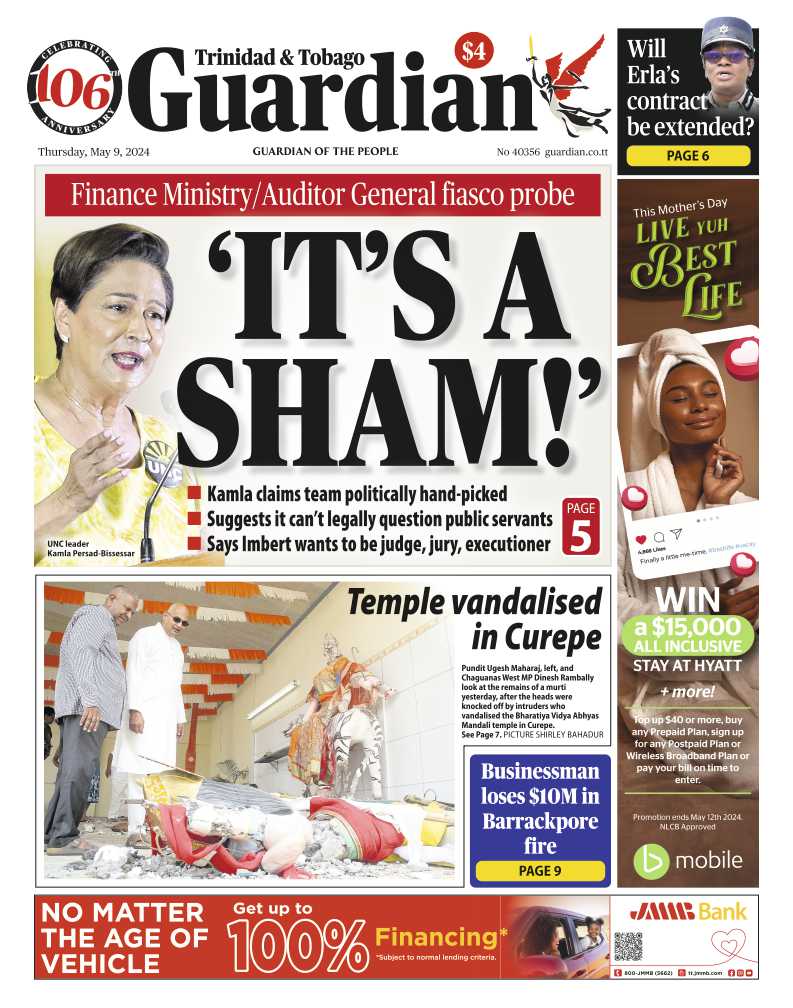
Prime Minister Kamla Persad-Bissessar has dismissed the Venezuelan government’s accusation that this country colluded with the US in the seizure of its oil tanker as “false propaganda.”
The Prime Minister said if the Venezuelan government has a problem with the seizure of the oil tanker “Skipper,” then they should take it up with United States President Donald Trump.
“They should direct their complaints to President Trump, as it is the US military that has seized the sanctioned oil tanker. In the meantime, we continue to have peaceful relations with the Venezuelan people.”
Persad-Bissessar also told Guardian Media she is unbothered by the Nicolás Maduro’s regime’s threat to “extinguish” all natural gas deals with Trinidad and Tobago.
The Prime Minister said, “We have never depended on Venezuela for natural gas supplies. We have adequate reserves within our territory. We are aggressively working to reduce bureaucratic barriers to speed up approvals for energy companies.”
Persad-Bissessar added,” The real issue is bureaucracy is hindering our exploration and production. “
Former energy minister and energy expert Carolyn Seepersad-Bachan also made it clear yesterday that recent developments involving Venezuela amount to no shock and or major blow for T&T, because there was never any gas supply coming into the country in the first place.
She insisted that the current situation simply confirms what has been the reality for some time: Venezuela is not a source of relief for the country’s worsening gas shortage. She said the framework governing unitisation agreements for cross-border fields remains in place, but it does not revive projects that were already stalled or shut down.
Seepersad-Bachan pointed out that the Dragon gas arrangement was never a unitisation agreement or a formal energy cooperation project. Instead, it relied on limited permissions that could not advance without approvals from the United States Office of Foreign Assets Control (OFAC). Those approvals, she noted, were never secured in a way that allowed production to proceed.
She explained that only two cross-border fields were ever potentially affected, Loran-Manatee and Coquina-Manakin. Loran-Manatee was de-unitised years ago after the United States declined to issue an OFAC licence during the Joe Biden administration. As a result, Trinidad and Tobago moved ahead independently, extracting only its share of the gas from the field.
Coquina-Manakin, she added, effectively came to a stop earlier this year when the OFAC licence was cancelled, bringing joint operations linked to Dragon Gas to an end. In that context, Seepersad-Bachan stressed that there is no immediate fallout now because production from those fields had already been halted or restricted.
There will be no negotiations and no gas supply coming from Venezuela under the current circumstances, she said, noting that the much-discussed six-month OFAC licence was never a licence to produce gas. Instead, it only allowed for the possibility of negotiations, which have since collapsed.
While the Government has indicated that the Dragon Gas OFAC licence remains technically valid, Seepersad-Bachan argued it has no practical effect. She pointed out that any progress would have required renegotiating long-term exploration and production arrangements with Venezuela, a process she said effectively ended when the broader energy cooperation framework was revoked.
Looking ahead, she warned that T&T must now look elsewhere for gas, as domestic reserves continue to decline and foreign exchange pressures mount. However, she cautioned against expecting quick solutions from other regional players.
Grenada, she said, remains far off the horizon, with prospective resources still at an early stage and no proven commercial gas volumes or infrastructure capable of supplying T&T in the near to medium term.
Suriname is also not a viable option for now, she added. While recent discoveries are significant, Seepersad-Bachan explained that the focus is on oil, not gas, and any gas-related infrastructure would take years to develop.
For the foreseeable future, she said, the country’s only realistic option is to accelerate development of its own acreage and pursue viable partnerships, accepting that Venezuelan gas will not be part of the equation.