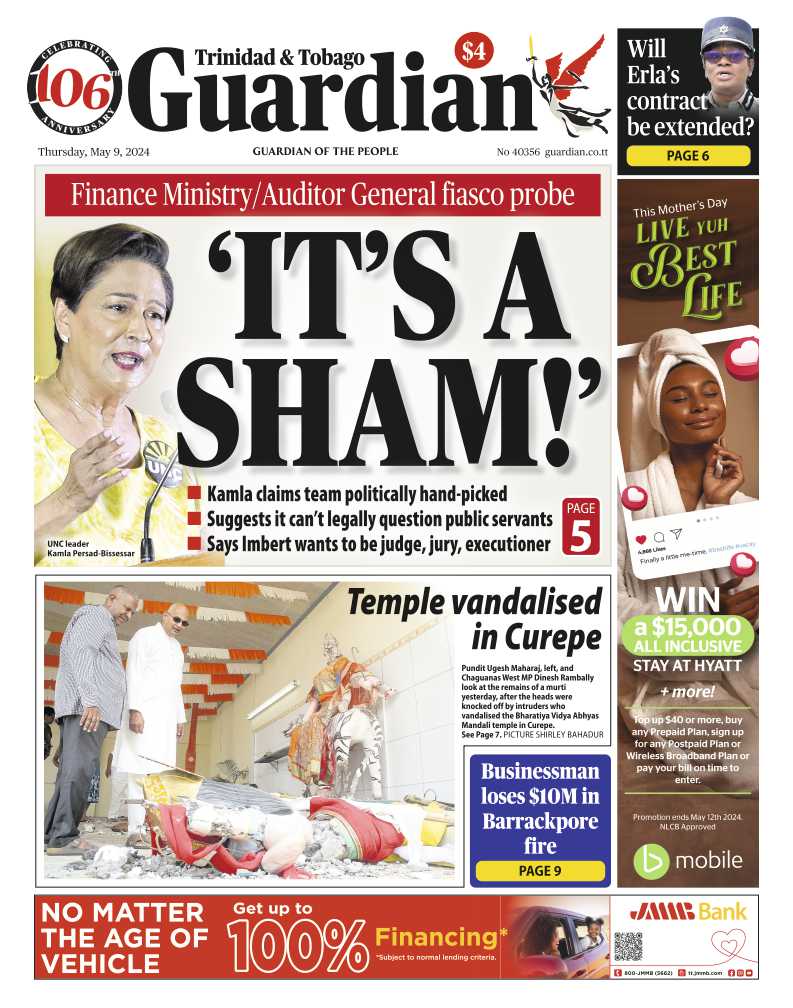
Caricom has been going through a stormy period recently. Prime Minister Kamla Persad-Bissessar’s challenge to the modus operandi of Caricom, including the functioning and operations of the secretariat and behaviour of the secretary general herself, escalated into a full-blown war. The Prime Minister has also reprimanded the political directorate for being less than transparent and accountable.
Strong voices have argued that Dr Carla Barnett’s resignation would be a positive step for Caricom, which would give the institution time to recalibrate. At least one investigative report has identified procedural flaws and constitutional breaches in the process of her reappointment, reinforcing the position of the T&T Government. It is unclear whether any offline discussion or back-room negotiations have been taking place to resolve the controversial matter, and perhaps more importantly, to get Caricom on a respectable, unifying pathway forward.
The conflict in Caricom is not just about the appointment of the secretary general. It has escalated into a major diplomatic and administrative feud about regional governance, transparency and accountability.
Where it stands now on the eve of the next Caricom meeting is that Trinidad and Tobago’s Prime Minister will not relent until structural reforms that support transparency are made in Caricom; until officials are held accountable; and she will not accept the process by which Dr Barnett has been reappointed, nor is she likely to accept her as secretary general.
The Prime Minister has noted T&T ‘s billion-dollar investment in Caricom over 52 years, and has made it clear that this country has no intention of exiting Caricom, in which it has invested so heavily. However, she has also indicated that she will publicly and relentlessly pursue the matters of concern to her in Caricom until they are properly addressed.
Besides the issue of the secretary general and her appointment, the Prime Minister is uncomfortable with foreign policy positions and the approach to regional security issues in Caricom. She feels that Caricom compromised itself with the Nicolas Maduro regime in Venezuela and failed to express solidarity with Guyana against Venezuela’s aggression on the Esequibo region dispute. Without naming countries or country leaders, she claims that there was political interference in Trinidad and Tobago during the 2025 election in favour of the People’s National Movement. She accused the organisation of being “dishonest, dysfunctional and incompetent” and of cronyism in recruitment practices.
The manner in which some Caricom noteables sought to discredit Foreign and Caricom Affairs Minister Sean Sobers’ account of events and his objections to the procedure used in Dr Barnett’s reappointment was also not respectful to the Trinidad and Tobago Government. And that approach of ridicule, dismissal and humiliation would not be acceptable to our Prime Minister.
If Barnett remains Secretary General of Caricom, the Persad-Bissessar Government will not engage her and will rethink its approach to its participation in Caricom. On the other hand, whether Caricom heads will concede that they made an error, that continuing to insist on a reappointment of Barnet will weaken the institution further and make it ineffective at a challenging time in geopolitical history, is difficult to anticipate.
It would be absolute folly for Caricom to proceed with business as usual at the St Lucia meeting on July 5, whether T&T’s Prime Minister attends or not. Common sense suggests that she will only go if a resolution that she can live with is agreed beforehand. If she does not attend, it will be either because no acceptable way forward has been reached behind the scenes, or she is waiting for the Heads to come to mutually acceptable decisions without her before she agrees to join the Caricom Leaders’ forum again.
But this region of the Caribbean and Latin America is in a mess, and the western hemisphere as a whole needs coherence, stability and an enlightened agenda on which countries can mutually agree. The three most important institutions in the hemisphere—Caricom, the OAS and CELAC—are in jeopardy.
Haiti, Cuba and Venezuela are not really politically settled. Ideological shifts are changing the tapestry and texture of foreign policy alignments. The Western Hemisphere is the most unequal region in the world. Drugs, guns, gangs and crime are weaving their way into constitutional power and legitimate business. AI and the need for quantum readiness are threatening to leave this Caribbean and Latin American region behind.
How will Caricom act in the best interest of a unified region and our anxious people who crave their place in the world?