We must not confuse equivalence with accuracy. It is not brilliant to place two historical facts side by side and simply declare them relevant. Sometimes that is precisely the art of deception: place two things next to each other, say little, and allow the mind to manufacture the conclusion. Some will call that social commentary. Calypso, soca and extempo have long mastered the double entendre. We Trinbagonians know how to say one thing while everybody understands another. But race talk requires context. And context requires consistency.
Before the intellectual argument, I am a father
I write this not because of the letters before my name, but because of what comes after it. Mwale means, among other things, endurance and unshakable courage. My last name, Henry, like yours, represents a family heritage: those who came before us and those who will come after us. I therefore have a sacred duty to both.
So, for a second, put aside the intellectual argument. Consider this a message from a father who has to sit at the kitchen table and explain difficult things to his 9- and 7-year-old children after they read the newspaper. Then, almost unavoidably, I must wade into the history, culture and sociology that guide that conversation.
Warning! When I move from commentary into the literature or pinch a nerve, doh run to the comments section or my inbox, or extract one random sentence to prove the prejudice you arrived with. Test what I have said on its merits. Paul preached. The Bereans went and checked. Truth does not need your loyalty. It needs your examination.
We already know how race talk works
In Trinidad and Tobago, the C-word and N-word are seldom used freely in mixed company unless somebody first understands the relationship, audience and boundaries. Go into a bar, barbershop or market. Even the man making the risky racial joke usually knows where the line is.
Among close friends, certain words may be tried, tested or tolerated because there is tacit agreement. But nobody assumes private permission becomes a public passport.
Sociologists from J S Furnivall to M G Smith wrestled with plural societies in which culturally distinct groups occupied the same political territory while maintaining important differences in identity and social organisation.
T&T complicates any rigid version of that model. Our society still has strong ethnic divisions, but people also share cultures, depend on each other and take part in many of the same institutions.
But we still understand how behaviour changes across social settings. When it is time to buy, sell, work, negotiate or achieve a common outcome, whatever prejudices someone may privately hold or express through satire, picong or even discrimination, we generally understand that different social settings carry different rules of conduct.
In Trinbago terms, we know what time it is.
The Speaker came before Star
That is why the Parliament of the Republic of T&T matters. The highest seat of democracy represents the collective wishes of all of society.
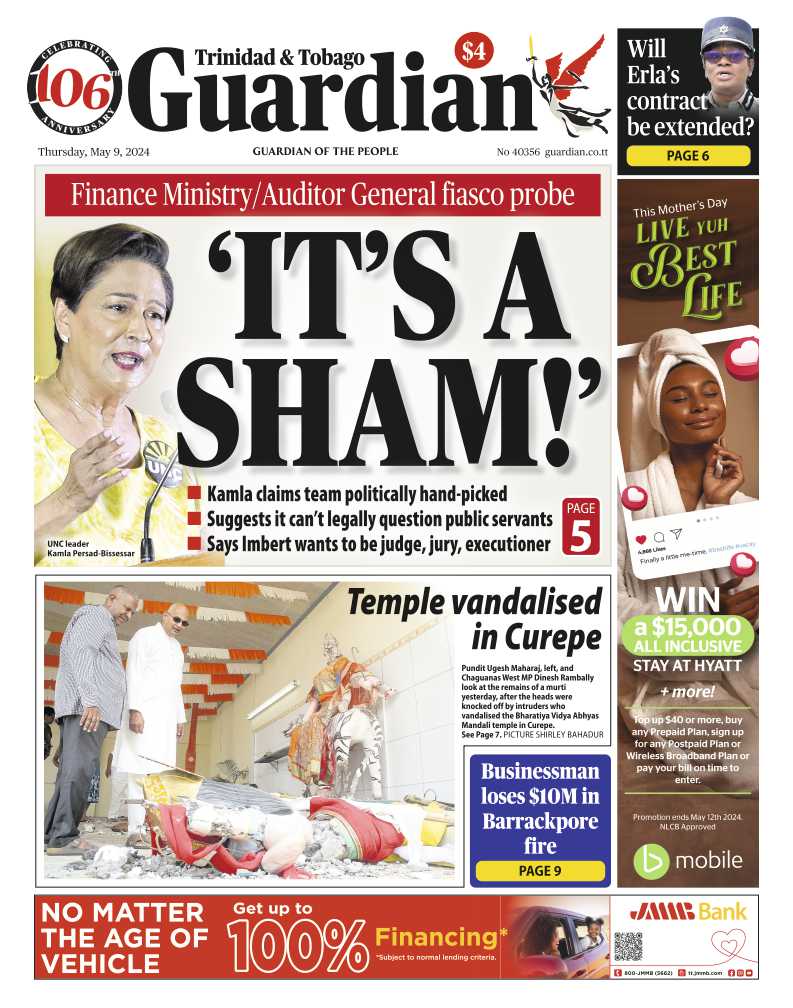
On March 24, 2026, Prime Minister Kamla Persad-Bissessar, speaking during Spiritual Shouter Baptist Liberation Day greetings in the House of Representatives, described herself as “this lil c***** girl from down wherever.”
Brian Manning, MP, objected, supposedly protesting the use of “offensive” or “unparliamentary language,” and asked: “Mr Speaker, are you going to allow that word on Hansard in this Parliament?”
Speaker Jagdeo Singh, an attorney, responded that it was “not a question of allowing the word,” saying the Prime Minister was relating an anecdote rather than directing the expression at another member.
The Prime Minister continued: “I call myself that…I am not ashamed.” And there it sits in our Hansard. That interests me because Parliament is not a private lime. Hansard is not WhatsApp. It is the official and permanent record of Parliament.
Then came the alleged Star Sabga recording. Remember the sequence of its public release: March came before July. The Speaker before Star. C before S.
Last time I checked my alphabet, that is still correct. The purported Sabga recording surfaced publicly months after the parliamentary exchange, allegedly containing deeply offensive racial language attributed to her.
I make no defence of racial contempt expressed in private, including in any recording, if authentic. But intellectually, we cannot begin the history with Star. The Prime Minister had already publicly resurrected the word months earlier.
Can you reclaim the poison without reopening the bottle?
There is research supporting reclamation. Social psychologist Adam Galinsky and colleagues found that members of stigmatised groups who self-label using derogatory terms can experience increased feelings of power.
Observers may also perceive them as more powerful. However, that is not the end of the story.
A 2024 study by Sa-kiera Hudson, Jolynn D Hudson and colleagues, “Implicit Attitudes Evoked by a Singular American Slur,” examined attitudes towards the N-word among more than 3,000 Black and White Americans. They found that even where conscious reappropriation occurred, deeply negative automatic associations with the racial slur remained. So reclamation can produce two movements at once.
The speaker hears empowerment. The wider society may hear normalisation. You may take the word back for yourself while accidentally putting it back into circulation for everybody else. The person may reclaim the word without the word surrendering its history. That is the sociological danger.
So who owns the C-word?
There is plainly a difference between an Indo-Trinidadian Prime Minister describing herself with the C-word and somebody using that word to demean her. I refuse false equivalence.
Context matters. Speaker identity matters. Intention matters. History matters. But difference does not eliminate consequence. If a historically degrading term becomes acceptable because the person speaking belongs to the affected group, what precisely is the rule for public discourse?
May I smile calmly and announce, “Here comes our c***** Prime Minister”? May an Afro-Trinbagonian parliamentarian stand and announce, “I am your N-word Member of Parliament”?
Would our television and radio stations broadcast racially reclaimed statements uncensored? Probably not. Nor would I. I respect the Prime Minister and its office too much, my fellow countrymen and women so much, and
I respect myself enough not to make such a choice. Therefore, herein lies the contradiction. Why should the official record of Parliament enjoy a racial vocabulary that responsible broadcasters or citizens would hesitate to transmit?
Why, Kamla?
This is where I genuinely ask the Prime Minister: why choose that word? Your political history provides volumes of material for self-deprecation and triumph without resorting to race.
Kamla Persad-Bissessar, SC, MP, has survived political blows from Basdeo Panday, Jack Warner and others who once stood much closer to her than her opponents across the aisle. There is no deeper political wound than one inflicted by someone close to you.
Yet after a decade in opposition, she brought the UNC out of the political wilderness and secured a commanding victory in April 2025, a ten-year wilderness the present PNM has not had to endure. That is a remarkable political comeback.
Your opponents tried to read your political obituary. You attended your own funeral and asked who ordered the flowers. So why make race the metaphor for a journey replete with so many other examples of overcoming adversity and triumph?
Sociologist and executive leadership adviser
mwale.henry@gmail.com