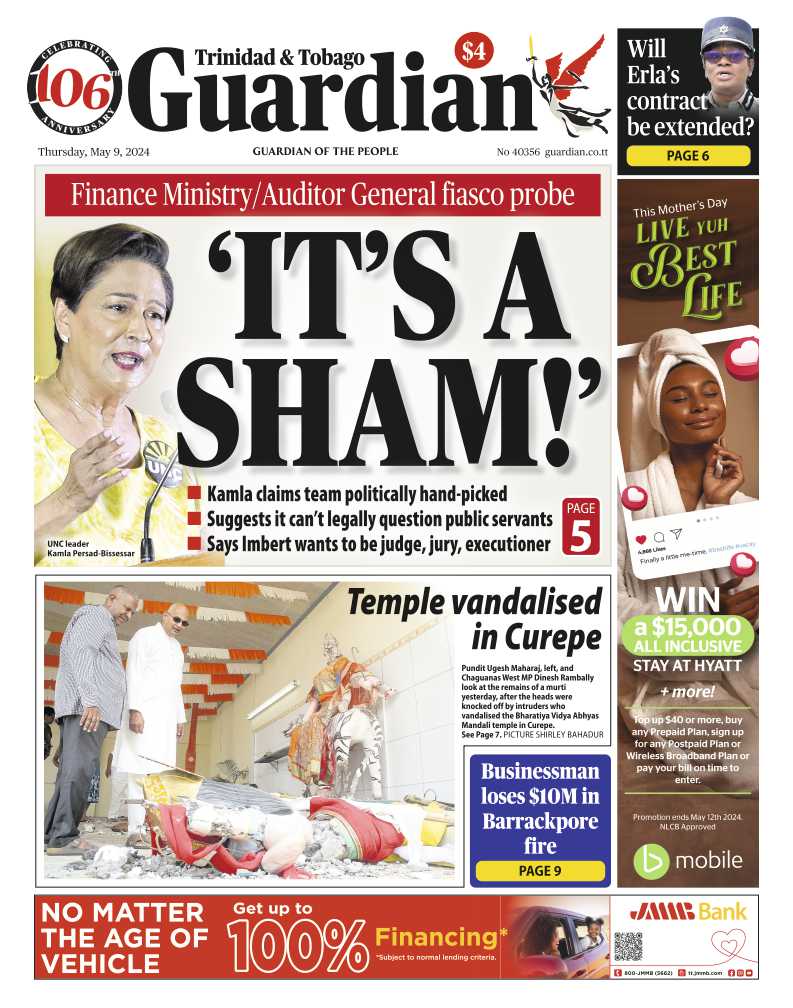
One year is a long time in politics. It is even longer in government. This week marks one year since Prime Minister Kamla Persad-Bissessar last attended a post-Cabinet media briefing, a development that has prompted the Media Association of Trinidad and Tobago (MATT) to seek talks with the Prime Minister regarding what it describes as a lack of formal media availability.
The issue is not whether the Prime Minister communicates with the public. She does. Through speeches, statements, social media posts, public events and occasional exchanges with reporters, her voice remains prominent in national discourse.
The issue is accountability.
Post-Cabinet media briefings occupy a unique place in our democratic landscape. They are among the few forums where journalists can pose unscripted questions to the country’s most senior elected officials and seek clarification on matters of national importance. They allow for follow-up questions, challenge assertions and provide the public with a clearer understanding of government policy.
For decades, successive administrations have used post-Cabinet briefings to explain government decisions and defend policy choices. Whether under Patrick Manning, Kamla Persad-Bissessar’s first administration or Keith Rowley, the briefing room became a space where government and media engaged directly.
Indeed, the current administration itself demonstrated the value of that engagement during its opening weeks in office.
The first post-Cabinet briefings following the 2025 general election captured national attention. The Prime Minister’s forceful exchanges with reporters generated widespread public interest. Her dramatic decision to tear up the Water and Sewerage Authority transformation plan before the cameras became one of the defining political images of the year. Other briefings produced memorable moments that dominated news cycles and social media discussions.
The public could witness Government in real time.
Yet, after June 5, 2025, that direct engagement largely ceased.
To be fair, Cabinet ministers have continued to appear before the media. Many have competently explained decisions within their portfolios. However, ministers cannot answer every question confronting the nation. When issues cross multiple ministries or involve broader government strategy, the public naturally expects answers from the person who leads the Cabinet.
Over the past year, this country has confronted major questions involving foreign policy, national security, energy, states of emergency and regional geopolitical developments. In many instances, ministers have declined to comment beyond their specific responsibilities, saying they have been instructed to remain within their remit.
That approach may preserve message discipline, but it leaves significant gaps in public understanding.
The Prime Minister recently remarked that her ministers are fully competent to answer questions. There is no reason to doubt their competence. But ministerial competence and prime ministerial accountability are not the same thing.
In a Westminster democracy, collective responsibility ultimately rests with the Cabinet and leadership responsibility rests with the Prime Minister.
This is why MATT’s concerns deserve serious consideration. Formal media briefings are not a favour to journalists. They are a service to the public. Reporters ask questions on behalf of citizens who cannot enter Cabinet rooms, attend diplomatic meetings or sit at the Government’s decision-making table.
The solution need not be burdensome. No one expects the Prime Minister to attend every briefing. But regular appearances at key intervals would strengthen transparency, improve public confidence and reaffirm the Government’s commitment to accountability.
The briefing room should not be viewed as a battleground. It is a cornerstone of democratic governance.
Prime Minister Persad-Bissessar should return to it.