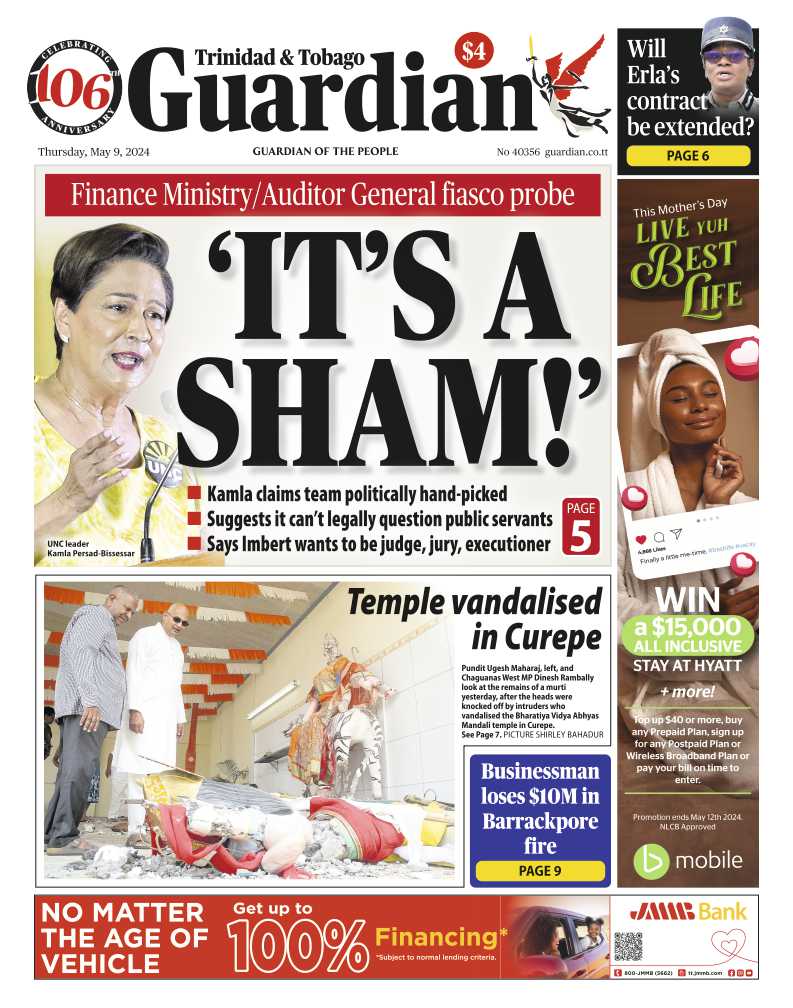
In her Independence Day message, Prime Minister Kamla Persad-Bissessar posed a challenging question: after more than six decades of self-government, how much longer can Trinidad and Tobago blame its shortcomings on its colonial past?
The question merits serious reflection, but so does the history that shaped the nation.
There is no denying that Trinidad and Tobago entered Independence in 1962 with notable advantages. It inherited functioning institutions, a developed petroleum industry, established agricultural sectors, physical infrastructure and, by regional standards, a relatively high standard of living. Economic indicators also suggest that the country was better positioned than several nations that have since surpassed it in development.
Yet comparisons with countries such as Singapore, Taiwan and Japan must be made carefully.
A relatively high income level does not automatically reflect stronger institutions, higher productivity, advanced technology or better education. Nor did the existence of oil production and colonial infrastructure mean that Trinidad and Tobago inherited a diversified economy capable of sustaining long-term growth.
The colonial economy carried significant weaknesses. It depended heavily on primary commodities and was marked by inequalities that influenced access to opportunity and political power.
Elements of that legacy remain evident today. Colonialism helped shape the starting point, but it does not fully explain the nation’s present circumstances.
The more important question is what Trinidad and Tobago did with the opportunities that followed.
The country benefited enormously from the oil boom of the 1970s and later from the growth of the natural gas and petrochemical sectors.
Those resources generated wealth that could have accelerated economic diversification, strengthened education, modernised infrastructure and expanded opportunities for future generations.
Instead, successive governments failed to transform that wealth into a sufficiently diversified and sustainable economy.
This is where the Prime Minister’s argument is most compelling. After 64 years of Independence, responsibility for the nation’s direction rests primarily with its citizens and leaders.
Governments have made choices. Institutions have succeeded and failed. Political parties have often prioritised short-term interests over long-term national development. Citizens, too, have sometimes tolerated inefficiency, patronage and corruption while expecting continued benefits from the State.
However, accountability must apply equally to those who govern today. If citizens are urged to stop blaming colonialism for current challenges, political leaders must also avoid blaming predecessors, inherited circumstances or external forces for failures that occur under their watch. Leadership requires ownership, not excuses.
The debate should therefore move beyond assigning responsibility solely to colonialism or to post-Independence governments. The reality is that both history and human agency matter.
Trinidad and Tobago inherited a mixture of strengths and weaknesses, then made choices that produced both notable successes and significant disappointments.
Independence is more than political sovereignty. It is the acceptance of responsibility for collective decisions and their consequences.
At 64, the nation should neither remain trapped by historical grievance nor indulge in nostalgia for 1962. Instead, it must confront a more important question: what kind of country can it build with the resources, talent and opportunities it possesses today?
That is the true responsibility of Independence. And after 64 years, the future depends not on who is to blame, but on what choices are made next.